
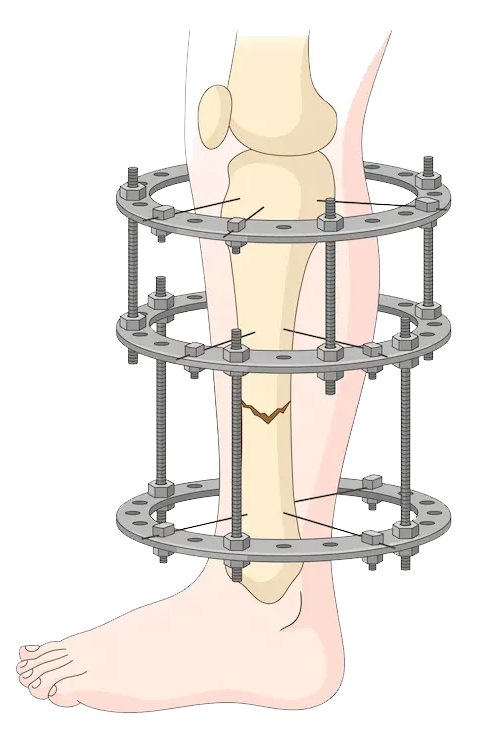
Limb Lengthening and Ilizarov Surgery are specialized orthopedic procedures used to manage limb length differences, complex bone deformities, difficult fractures and certain bone-healing problems. These techniques use controlled bone regeneration to restore limb length, alignment and function in appropriately selected patients.
Ilizarov treatment uses an external fixation frame that provides controlled support to the affected bone. It can be used for gradual correction of deformity, bone lengthening and reconstruction in complex orthopedic conditions where conventional treatment may be challenging.
Ilizarov surgery is based on the principle of gradual bone distraction. A specialized circular external fixator is attached to the bone using fine wires and/or pins. When appropriate, the bone is carefully divided and the two bone segments are gradually moved apart under controlled conditions.
This gradual process stimulates the body to form new bone within the developing gap. At the same time, the alignment and length of the limb can be carefully controlled during treatment.
Limb lengthening and Ilizarov techniques may be considered for a variety of orthopedic conditions depending on the patient's age, bone condition, deformity, overall health and functional requirements.
The treatment is performed in carefully planned stages. The exact rate and duration of lengthening depend on the bone involved, the patient's condition and the treatment objective.
Recovery from Ilizarov treatment requires regular clinical follow-up and a structured rehabilitation programme. Patients may need physiotherapy to maintain joint movement, muscle strength and functional mobility during the treatment period.
Pin and wire care, weight-bearing instructions and regular imaging are important parts of treatment. The duration of frame application and overall recovery varies considerably depending on the condition being treated, the amount of correction required and the patient's individual healing response.
Because limb lengthening and deformity correction are highly individualized procedures, detailed assessment and treatment planning by an experienced orthopedic specialist are essential before surgery.